
Bull and Bear Cases
Five assets, both sides of each argument stated as strongly as I can make them, and the specific level or event that would settle it. Bitcoin, Ethereum, Zcash, NEAR and Hyperliquid.
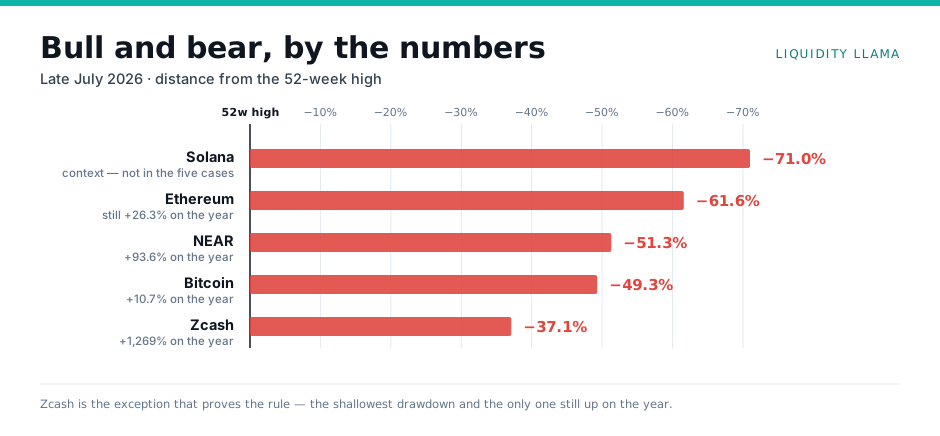
The board
| Asset | Price | From 52w high | Above 52w low | Range position |
|---|---|---|---|---|
| Bitcoin | 63,992 | −49.3% | +10.7% | 9% |
| Ethereum | 1,902 | −61.6% | +26.3% | 11% |
| Zcash | 471.78 | −37.1% | +1,269% | 61% |
| NEAR | 1.628 | −51.3% | +93.6% | 31% |
| Hyperliquid | ~65–72 | — | ~+250% from Jan low | — |
| Solana (context) | 73.55 | −71.0% | +22.3% | 7% |
Range position is where price sits between its 52-week low and high — 0% is at the low, 100% at the high. It's a cleaner read than any oscillator because it can't be smoothed, lagged or tuned: it simply states where the market has settled within the range it has actually traded.
The first thing worth noticing is the dispersion. This is not a market where everything moves together: Zcash is up thirteen-fold from its low, Hyperliquid has roughly tripled since January, and Solana is 71% below its high. A bear market that produces that spread is one where the individual arguments matter more than the beta.
Bitcoin — $63,992
- Holding above the cycle low +10.7%
- Unchanged on a −2% Nasdaq session
- Flat on a −2% Nasdaq day
- Drawdown normal by historical standards
- ETF access and institutional custody are structural
- −49.3% from the high is a real bear market
- Long yields at 52-week highs (TLT at lows)
- 2018 and 2022 both exceeded −70%
- Aggregate technical rating: sell
- Correlation to equities rises in stress
The bull argument, stated properly: a 49% drawdown is unremarkable for Bitcoin — it has done this repeatedly inside long-term uptrends. What is different this time is the holder base. ETFs, corporate treasuries and regulated custody mean a meaningful share of supply is held by entities that don't panic-sell on a 20% weekly move. The price action supports this: Bitcoin was unchanged today while the Nasdaq fell 2% and semiconductors fell 4.8%. An asset in active liquidation does not do that.
The bear argument, stated properly: Bitcoin is a zero-cash-flow, maximum-duration asset, and the discount rate is the entire valuation. Long yields are at 52-week highs. Every prior Bitcoin bear market went deeper than this one and lasted longer — 2018 and 2022 both exceeded 70% peak to trough. From $126,200 that implies something near $38,000. Nothing about ETFs repeals the discount rate.
Ethereum — $1,902
- Recovered furthest off its low of the majors
- +26.3% above its low, well clear
- Only major with a positive technical rating
- Productive asset with real fee revenue
- Valuation reset is severe and mostly done
- −61.6% — worse than Bitcoin by 12 points
- ETH/BTC in structural decline
- L2s and rivals capture activity and fees
- Complex story penalised in risk-off
- No single legible reason to own it
Bull: Ethereum is the only major here with a positive aggregate technical rating. It is 26% above its low while Bitcoin is 11% above its — on a relative basis, ETH has been recovering harder off the bottom. It is also a genuinely productive asset: fees are earned, supply is burned, staking yields exist. At $1,902 against a $4,957 high, a great deal of disappointment is already priced.
Bear: the 12-point gap in drawdown versus Bitcoin is not noise — it is the market expressing a preference. Ethereum's value accrual depends on activity staying on mainnet, and layer-2s have absorbed much of it while charging a fraction. In risk-off conditions capital consolidates into the most legible asset, and Ethereum's story requires several paragraphs where Bitcoin's requires one sentence.
Zcash — $471.78
- +1,269% from its 52-week low
- Only −37% off high — best of the group
- Green today while majors are flat/down
- Near-neutral technical rating (−0.06)
- Privacy demand is structurally rising
- A 13× move invites profit-taking
- Already 37% off the high — unwind started
- Regulatory risk is asymmetric and real
- Exchange delisting risk in some venues
- Narrative-driven moves reverse quickly
Bull: Zcash is the outlier of this entire group and it isn't close. From $34.45 to $750 and back to $471.78 — up thirteen-fold from the low while Bitcoin halved. It is green today. That kind of relative strength in a broad crypto bear market usually reflects a genuine change in perceived value rather than beta, and the obvious candidate is privacy: as surveillance of on-chain activity increases and institutions hold transparent-ledger assets, shielded transactions acquire a scarcity value they didn't previously have.
Bear: a thirteen-fold move creates an enormous population of holders sitting on large gains, and those positions get defended nervously. It is already 37% off its high, which means the unwind has started. And privacy coins carry a regulatory tail risk unlike anything else here — a single major-jurisdiction ruling or a wave of exchange delistings can impair liquidity permanently, regardless of the technology's merit.
NEAR — $1.628
- Positioning heavily compressed
- Still +93.6% above its 52-week low
- Green today despite weak momentum
- AI-adjacent narrative optionality
- No relative strength anywhere in the group
- −51.3% from high, no relative strength
- L1 competition is brutal and consolidating
- Its AI angle is exposed to the AI unwind
Bull: NEAR sits at 31% of its 52-week range and is green today despite the weakest momentum in the group. If crypto beta turns, high-beta layer-1s with compressed positioning move furthest fastest — that is the entire argument, and it is a beta argument rather than a NEAR argument.
Bear: being the most oversold asset in a group is not a distinction to seek. NEAR has neither Bitcoin's institutional bid, Ethereum's fee revenue, Zcash's relative strength nor Hyperliquid's cash flows. Layer-1 competition has been consolidating toward a few winners for years, and it is not obvious NEAR is one. Worse, its AI-adjacent positioning is a liability rather than an asset in a week when the AI trade is precisely what's unwinding.
Hyperliquid — ~$65–72
- ~$1bn cumulative protocol revenue
- ~99% of fees routed to open-market buybacks
- ~$74m/month of buying, ~$0.9bn trailing
- 60–80% of decentralised perp market share
- ~$6.5bn daily volume, $3.5bn open interest
- +250% from its January low of $20.50
- Revenue is a direct function of speculation
- Crypto bear ⇒ volumes fall ⇒ buyback shrinks
- ~$14.5bn cap on ~$1bn cumulative revenue
- Dominant share invites well-funded attack
- Treasury-company demand is reflexive
Bull: Hyperliquid is the one asset here with a mechanism that resembles equity. It earns real revenue — over $1bn cumulatively — and routes roughly 99% of it into buying its own token on the open market, around $74m a month. That is a dividend and a buyback in one, funded by cash flow rather than emissions. It commands 60–80% of decentralised perpetuals with $6.5bn daily volume, and it is up roughly 250% from its January low in a period when Bitcoin halved. In a market full of assets searching for a reason to exist, this one has a P&L.
Bear: the quality of that revenue is the entire question. Hyperliquid earns fees from leveraged crypto speculation. In a deepening bear market, volumes fall, fees fall, and the buyback — the main structural bid — shrinks exactly when the token most needs support. The flywheel runs in reverse as efficiently as it runs forward. A roughly $14.5bn valuation against $1bn of cumulative revenue is not obviously cheap, and market share of 60–80% is the kind of prize that attracts extremely well-capitalised competition, including centralised exchanges with their own chains.
How I'd rank the arguments
Not recommendations — an honest ordering of which bull cases rest on the most verifiable evidence:
- Hyperliquid — the only one with measurable cash flows and a mechanical bid. Also the only one whose thesis can be falsified monthly, which I value highly.
- Bitcoin — weakest downside case of the majors, holding above its low, behaving with more stability than the equity complex around it.
- Zcash — the strongest price evidence on the board, but the least explicable and with genuine regulatory tail risk.
- Ethereum — best technicals among the majors, but the ETH/BTC ratio has to stop falling before the rest matters.
- NEAR — the bull case is essentially "it's oversold," which is the weakest argument available.
For educational purposes only. Cryptoassets are highly volatile, largely unregulated, and losses can be total. Nothing here is investment advice or a recommendation to buy or sell any asset. Both cases are argued deliberately — presenting a bull case is not endorsing it.