
Silver, Software and Silicon
Silver has halved from its high. The data-centre demand story turns out to be roughly 4% of industrial consumption. Meanwhile software is rallying 4–6% on a day memory falls 10%. Three connected questions, one underlying cause.
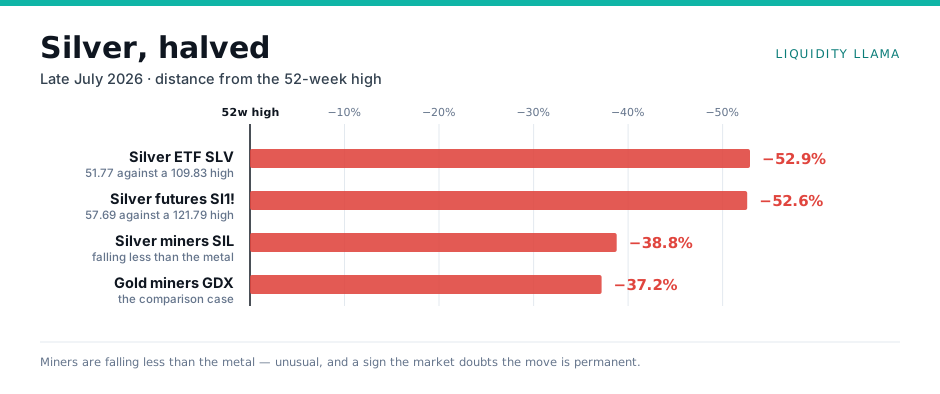
Where things stand
| Instrument | Last | Day | 52w high | 52w low | From high |
|---|---|---|---|---|---|
| Silver futures (SI1!) | 57.69 | −0.69% | 121.79 | 36.40 | −52.6% |
| Silver ETF (SLV) | 51.77 | +0.14% | 109.83 | 33.10 | −52.9% |
| Silver miners (SIL) | 72.94 | −1.42% | 119.24 | 47.09 | −38.8% |
| Gold miners (GDX) | 73.57 | −0.86% | 117.18 | 51.37 | −37.2% |
Note the distinction: silver metal is around $57.69 on the front future. SLV is an ETF trading at $51.77 and tracks the metal at a different absolute level — the "$50 silver" question refers to the metal, roughly 13% below spot.
Part 1 — Silver: the AI story is mostly not true
The narrative through the rally was that AI and data-centre buildout were structurally repricing silver. Silver is the most electrically conductive element; data centres need switching, connectors and power infrastructure; therefore AI demand is a new secular driver. It's a tidy story. The numbers don't support the weight placed on it.
The Silver Institute estimates data-centre-related silver demand at roughly 20–30 million ounces annually in 2026, up from under 10 million ounces five years ago. That growth rate is real and impressive in percentage terms. But total industrial consumption is forecast at around 639.6 million ounces. Data centres are therefore about 3–5% of industrial demand, or roughly 2–3% of the total market.
This matters directly for the question asked. If the AI trade has topped, the mechanical hit to silver demand is small — a few percent of industrial consumption at most, and that assumes data-centre buildout stops rather than merely slows. The AI-silver linkage was always more a story that justified a price than a driver that created one.
Which raises the more useful question: if AI wasn't the driver, what was — and is that driver still intact?
What actually moved silver
- Solar, an order of magnitude larger. Photovoltaic demand is around 194Moz — roughly seven times data centres. And it is falling, down about 7% year on year, because manufacturers responded to high prices by thrifting: redesigning cells to use less silver per panel. That is the single most important demand-side fact in the market.
- A six-year structural deficit. Supply has trailed demand for six consecutive years. Deficits draw down above-ground stocks, and depleted stocks are what make a market vulnerable to squeezes. This is the genuine structural argument.
- Investment and monetary demand. The most volatile component, and the one that took silver from the $30s to $122. Investment demand is reflexive — it rises because the price is rising — which is precisely why the retracement has been so violent.
Part 2 — Is $50 a buying area?
Silver is at roughly $57.69, having been to $121.79 and $36.40 within the same twelve months. That range tells you most of what you need to know about the character of this market.
The case for $50 as a level that matters
$50 is not an arbitrary number. It was the peak in 1980 and again in 2011 — a level that capped silver for over forty years. When a market finally breaks through a generational ceiling and then falls back to it, that level becomes the test of whether the breakout was structural or speculative. In classical terms, resistance becoming support.
So $50 is a genuinely meaningful area to watch, and it's the right level to have identified. Two caveats on how much weight to put on it:
- My own 503-session study found that even the best levels hold only 55–58% of the time on first touch, and that highs and midpoints are coin flips. Well-known levels are where liquidity sits, which makes them as likely to be swept as respected.
- A level defended by everyone is a level everyone has orders at. The $50 area is the most-watched number in the silver market — which increases the odds of a sweep through it before any reversal.
What the forecasters say
| Source | Forecast | Period |
|---|---|---|
| J.P. Morgan | ~$81/oz average | 2026 |
| ING (revised down from $84) | $68/oz | Q3 2026 |
| ING | $74/oz | Q4 2026 |
| Spot now | $57.69 | 30 Jul 2026 |
Both houses are forecasting materially above spot. Treat that with appropriate scepticism — ING has already cut once, and sell-side commodity forecasts are notoriously trend-following. But it does establish that the current price is below where informed analysts think fundamentals sit, and that's a different situation from a market priced for perfection.
My honest read
Momentum is still negative — price below its long-term trend, and miners underperforming the metal, which is the classic sign that the market doubts the price is sustainable (miners are a leveraged call on the commodity and usually lead in both directions). Buying into that on the argument that a level "should" hold is the mistake the backtest data warns against. But the structural picture — six-year deficit, depleted stocks, industrial demand at 60% of consumption — is intact and is not meaningfully damaged by an AI slowdown.
That combination argues for a specific approach rather than a call: a level to prepare for rather than a price to chase. If silver reaches the $50 area, the questions worth answering are whether it sweeps and reclaims (my trigger, not the level itself), whether the miners lead or lag, and whether investment demand has stopped falling. A sweep of $50 that reclaims within days is a materially different event from a weekly close below it.
Part 3 — Software versus hardware: the rotation is happening today
Today's session is an unusually clean illustration of the split.
| Software | Day | From 52w high | Hardware | Day | From 52w high |
|---|---|---|---|---|---|
| Adobe | +5.72% | −29.0% | Micron | −9.94% | −41.1% |
| ServiceNow | +4.65% | −41.1% | AMD | −5.51% | −26.5% |
| Salesforce | +3.79% | −30.0% | Intel | −5.12% | −42.5% |
| Microsoft | −0.71% | −29.7% | Nvidia | −3.55% | −19.7% |
| Palo Alto | −1.52% | −14.8% | ASML | −2.04% | −22.5% |
Three application-software names up 4–6% on a day the Nasdaq fell 2% and semiconductors fell 4.8%. Money moving into one group on a day of broad selling is the signature of a deliberate reallocation rather than a passive drift — passive flows don't discriminate.
Why it's happening
The market spent two years assuming AI value would accrue to whoever sold the compute, and that application software would be disrupted by AI rather than benefit from it. Software multiples compressed hard as a result — Salesforce is still 30% below its 52-week high, ServiceNow 41% below, Adobe 29% below, despite today's rally.
What's changing is the recognition that the economics differ fundamentally at each layer:
- Hardware carries the capex risk. Fabs, HBM capacity and packaging require capital committed years ahead of demand. If AI spending slows, the assets remain and the depreciation continues. Cyclical, capital-intensive, and currently priced for a shortage that may not persist.
- Software captures margin without carrying the capex. If AI tooling makes applications more valuable, that flows to gross margin. And critically, software firms are customers of falling compute prices, not suppliers into them.
Micron down 9.9% is the tell. It's the purest expression of the memory shortage trade, and it has now fallen 41% from its high. When the best-positioned beneficiary of a shortage falls that hard, the market is questioning the shortage's duration, not the current quarter's earnings.
Part 4 — The 2027 chip supply question
This is the crux of the hardware side, and the professional disagreement is stark.
The shortage-persists camp
- Samsung and SK hynix have both warned that AI-driven HBM shortages could last into 2027 and beyond.
- Micron reports DRAM and NAND demand exceeding supply through calendar 2027.
- Meaningful volume from new US and Asian fabs isn't expected until 2028 — so even fully funded capacity doesn't relieve 2027.
- Roughly $22bn of customer prepayments have been made to lock in memory supply. Hyperscalers are treating HBM access as a structural bottleneck, not a cyclical one — and prepayment is a costly signal.
- HBM is structurally hard to scale: each bit consumes more wafer area and advanced packaging than commodity DRAM, so capacity expansion is slower and more capital-intensive than headline fab numbers suggest.
The oversupply-is-coming camp
- Bloomberg Intelligence's Shuli Ren argues the shortage peaked in Q2 2026 and the market could tip into oversupply by 2028.
- TechInsights forecasts an industry downturn by 2027.
- The historical base rate is unambiguous: semiconductor shortages end in gluts. Capacity is added at the top, arrives late, and arrives all at once.
My working assumption: the shortage is real and probably runs through 2027, and memory equities have nonetheless likely seen their cycle high. Those aren't in conflict. The trade and the fundamental peak at different times, and the equity turns first.
What connects all three
Silver, memory and software are expressions of the same underlying question: what happens to assets whose valuations were justified by AI-driven demand, when AI-driven demand is repriced?
The answer differs by how much of the price was actually built on that story:
- Silver — the AI story was ~3–5% of demand, so an AI top costs it little directly. Its real exposure is to industrial demand broadly and to solar thrifting. The structural deficit survives an AI slowdown.
- Memory and semis — the AI story was the entire thesis. This is where the repricing is concentrated, and where it should be.
- Software — was priced as a victim of AI. If that assumption is wrong, it re-rates upward. Today suggests the market has begun to test that.
What I'm watching
- Silver: behaviour at $50 — sweep-and-reclaim versus weekly close below. Miners (SIL) leading or lagging the metal. Solar thrifting data in the next Silver Institute update.
- Hardware: whether memory prepayments continue or stall; any change to HBM capacity guidance; whether Micron's decline stops at the 41%-off-high level or extends.
- Software: whether today's 4–6% moves hold for more than a week. One session is a data point, not a trend — and software has had several failed bounces this year.
For educational purposes only. Market data as at 30 July 2026 via TradingView; forecasts cited are third-party and frequently revised. Nothing here is investment advice or a recommendation on any security or commodity. Silver is a volatile asset and mining equities carry additional operational and jurisdictional risk.
Sources
- Silver Institute — Sixth Consecutive Annual Market Deficit
- INN — Silver Institute: Sustained Supply Deficit Exposes Market to Squeezes
- Carbon Credits — Silver in 2026: Solar Substitution and a Market in Deficit
- INN — Silver Price Trends: Q2 2026 Review and Forecast
- Tom's Hardware — Samsung and SK hynix warn memory shortages could last to 2027
- Silicon Analysts — Micron Confirms Structural HBM Supply Deficit Beyond 2027
- HBM Shortages to Stretch Into 2027, Memory Makers Warn
- SemiAnalysis — Scaling the Memory Wall: The Rise and Roadmap of HBM