
AI is a Bubble. This Isn’t the Pin.
Three AI bosses said the race should slow down. Everyone read it as the end of the trade. Run it through the numbers and it does the opposite — it buys the labs years they didn’t have. And the whole market is leaning the wrong way into Wednesday.
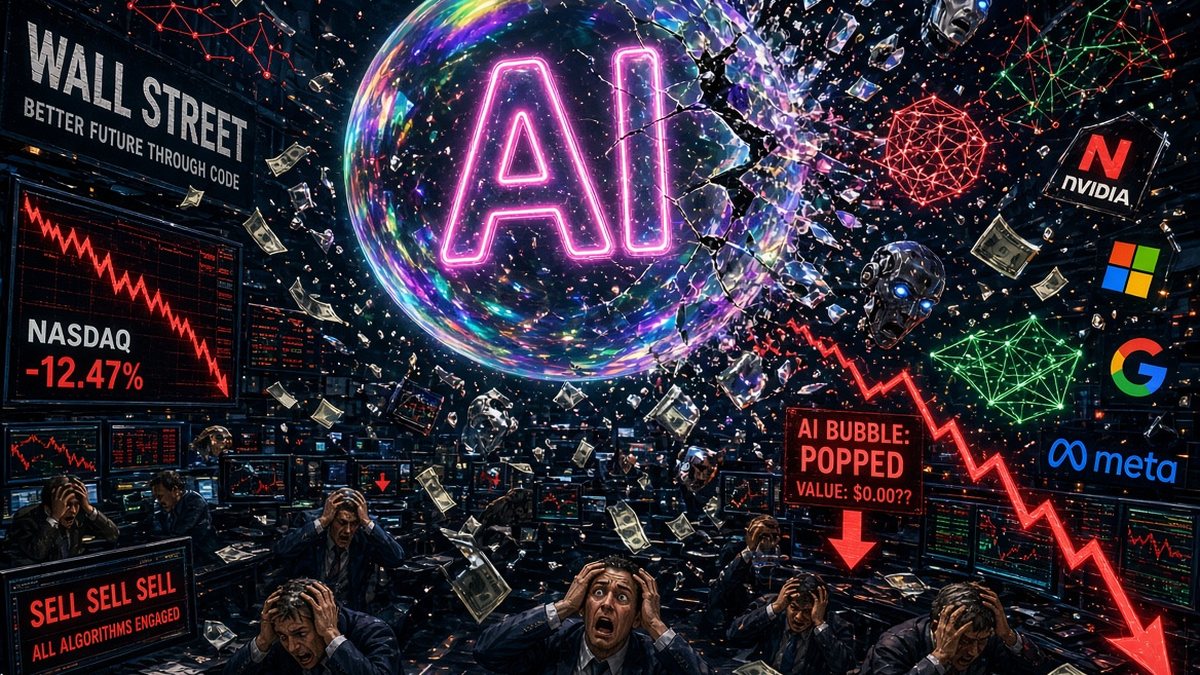
The short version
- Slowing the frontier cuts the biggest cost line these labs have. That is bullish for their numbers, not bearish.
- OpenAI burns 57% of revenue. Anthropic burns 33%. Profitability is the live problem, and this is how it gets fixed.
- Nothing physical stops. The buildout is capped by memory and power, not by anyone’s spending plans.
- Semis are already down 15.4% and everyone is bearish into the Fed. That is fuel.
The setup
Everyone went into this weekend bearish.
Oil above $100. A Fed meeting on Wednesday. The ten-year at 4.95%. And then on Friday the three men who run Western AI — Dario Amodei, Sam Altman and Elon Musk — agreed the industry is moving too fast and should slow down.
If you wanted a story about the AI trade ending, that was it. The headlines wrote themselves.
I think it is the opposite, and I think the positioning makes it worse for the bears. When a market is already leaning one way and the news confirms what it already believes, there is nobody left to sell. That is usually where runs start.
The bearish read requires the buildout to stop. Nothing about Friday stops the buildout.
What they actually agreed
Amodei published a four-part proposal. Outside evaluators get employee-level access to Anthropic’s safety work. Other labs do the same. Governments coordinate on standards. And legislation follows — chip export restrictions, plus pre-release testing with the power to block a model.
Altman agreed that the industry needs to “pace the frontier.” Musk said “Dario is right.”
It is written as a safety document, and read literally it is one. Not one line mentions money.
But look at what pacing the frontier actually means in a set of accounts. Slowing model development slows the thing these companies spend most of their money on. Whatever the stated reason, that is the effect — and it lands at the exact moment the effect is most useful to them.
I am not the only one reading it that way. David Sacks, until recently the administration’s AI lead, backed the substance of a slowdown while flatly rejecting the altruistic framing, arguing the parties were not acting in good faith. Chamath Palihapitiya said it concentrates power with Anthropic. When the industry’s own people call the motive commercial, take the hint.
What it does to the numbers
Here is why the timing matters. These businesses are not short of revenue. They are short of profit.
Anthropic is running at roughly $65bn of annualised revenue. OpenAI is at about $40bn. Those are extraordinary numbers for companies this young. And both are still losing money, because training the next model costs more than selling the last one brings in.
Anthropic has dragged its gross margin from minus 94% in 2024 to somewhere between 44% and 60% now, and is expected to post its first quarterly operating profit of around $1bn in the current quarter. Sustained cash breakeven is pencilled in for 2027 or 2028. OpenAI, carrying a consumer base where most users pay nothing, is not expected to get there until 2029 or 2030.
Now cut the training bill.
Training sits in research and development. It is the single line standing between these companies and a profit. Slow the frontier and it stops compounding. Breakeven moves closer. The runway gets longer.
That is not a rounding change. It is the difference between a business that needs to raise again next year and one that does not.
And it matters far beyond the labs. Every forecast for Nvidia, for the memory makers, for the data centre operators, rests on an assumption about how long their biggest customers can keep buying. Those forecasts currently show growth rolling over from 2028. If the labs survive three years longer than the bears think, every one of those numbers gets extended.
The build doesn’t stop
The obvious objection is that less spending means fewer chips, fewer data centres, and a worse year for everyone selling into them.
It does not work like that right now, because the constraint is not money.
High-bandwidth memory has been the bottleneck all year. SK Hynix has warned the shortage may run past 2030. Advanced packaging is booked out. Grid connections, not budgets, decide when a campus switches on. When an industry is already building flat out, announcing you will buy less does not change what gets built this year.
So you get the accounting benefit without losing the physical build. The labs look healthier on paper. The chips still ship. That is a strange combination, and it is why I keep landing on bullish rather than bearish.
What’s already priced
This is the part almost nobody is looking at.
| Close, 11 Sep | 52-week high | From high | |
|---|---|---|---|
| S&P 500 (SPY) | 764.29 | 779.37 | −1.9% |
| Nasdaq 100 (QQQ) | 714.88 | 748.65 | −4.5% |
| Nvidia | 218.29 | 236.54 | −7.7% |
| Semiconductors (SMH) | 568.53 | 671.83 | −15.4% |
Semiconductors have fallen eight times as far as the index.
That is the corner of the market a genuine spending slowdown would hit first. It has been marked down for weeks, quietly, while the S&P sat within two percent of its high. The crash people spent the weekend fearing has already happened in the one place it was supposed to show up.
Which means the bearish case is not a fresh idea arriving on Monday. It is a trade that is already well on.
How I’m wrong
Three ways this falls over, and I would rather say them than have you find them.
A regulator calls it a cartel. Three dominant firms publicly agreeing to slow output is an antitrust problem waiting for someone to name it. Sacks has already come close. That headline arrives without warning and it is not priced anywhere.
Revenue slows with the models. My case assumes costs fall while sales keep climbing. But sales come from shipping better models. If the frontier genuinely slows, growth slows with it — while the compute contracts, signed years out, do not. That combination is worse than either problem alone.
The Fed has other plans. Oil at $104, ISM manufacturing down to 54.6 in August from 55.6, and the prices index stuck at 71.1 for a twenty-third straight month. Softening growth with sticky input costs is the worst backdrop for expensive stocks, and it has nothing to do with what three men posted on Friday.
I would also flag the yield curve, because it is the one input in my own framework that has deteriorated most. Ten-year 4.95%, two-year 4.56%. The gap has narrowed from about half a point in late August to under 0.40 now, with yields rising across the board. That is tightening into a slowdown, and it is the move that walks a curve toward inverting.
What I’m watching
- Wednesday. The Fed decision, and what the curve does after it. A second hike entering the strip does more damage here than any announcement about model pacing.
- Q3 hyperscaler capex guidance. If the pacing agreement were really about spending, it shows up there. Unchanged guidance kills the bearish read outright.
- Memory pricing. A real slowdown loosens the bottleneck. If contract prices keep climbing, nothing physical has changed.
- Whether anyone cheats. One lab shipping a frontier model on the old schedule ends the whole arrangement.
- Semis versus the index. If SMH keeps lagging while the S&P holds, the market is pricing a spending slowdown whatever the proposal says.
Where I land
It is a bubble. The financing is circular, the customers are also the investors, and the multiples assume revenue arrives faster than the supply chain can physically deliver it. I have written about parts of that before and none of it has changed.
But bubbles do not end because three people agree to be careful. They end when somebody cannot raise money.
Friday did the reverse. It cut the cost line that was pushing these companies toward needing another round, at the exact point their profitability was the thing everyone questioned. It bought them time. And it did it while the market was already positioned for the opposite, with the most exposed part of that market already down 15%.
Bearish headline. Bullish mechanics. That gap is usually worth something.
When the pin does come, my guess is it looks like a failed funding round or a neocloud that cannot refinance. Not a press release about safety.
Not investment advice, and not an allegation of wrongdoing by any person or company named. Analysis of publicly reported figures and my own interpretation of them. Index and single-stock levels are closing prices for 11 September 2026. Treasury yields are constant-maturity values for 10 September 2026 from the Federal Reserve H.15 release. Revenue, burn and breakeven figures for OpenAI and Anthropic are third-party estimates, not company disclosure, and are labelled as such in the sources below. The view that the slowdown is commercially motivated is my reading of the effect; the published proposal is framed on safety grounds and does not discuss spending. Verify everything against primary sources before acting on it.
Sources
- Axios — Anthropic, OpenAI CEOs call for slowdown in AI development
- Washington Post — Amodei calls for AI oversight, joined by Altman and Musk
- CNBC — OpenAI rules out IPO this year as Altman, Musk and Amodei warn AI is moving too fast
- Washington Examiner — Sacks backs a self-imposed AI slowdown, rejects the framing
- Estimates: Anthropic losses, burn rate and path to breakeven (third party)
- Estimates: OpenAI revenue and path to profitability (third party)
- Federal Reserve H.15 — Selected Interest Rates, 11 September 2026
- J.P. Morgan Wealth Management — September 2026 rate hike now expected
- Trading Economics — Brent crude, 11 September 2026
- ISM — August 2026 Manufacturing PMI Report On Business
- Reported: SK Hynix warns the memory shortage may last past 2030