
The SpaceX House of Cards
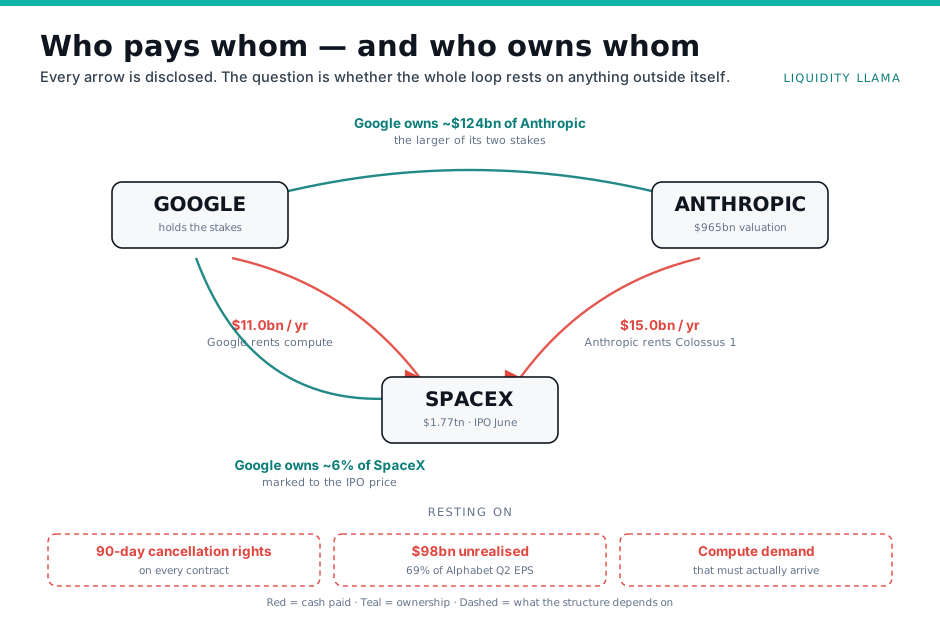
Google booked $98bn of unrealised gains on Anthropic and SpaceX last quarter — 69% of its earnings per share. Those same two companies are now paying SpaceX $26bn a year for compute. Every arrow is disclosed. The question is whether the loop rests on anything outside itself.

The argument in four lines
- Google’s record quarter was mostly unrealised marks on two private stakes — $98bn of a $112bn profit, 69% of EPS.
- Those two companies, Anthropic and SpaceX, are the payer and the recipient in $26bn a year of compute contracts.
- Those contracts are reportedly cancellable on 90 days, against capital that takes years to depreciate.
- Nothing here is hidden or illegal. The claim is narrower: the quality of this revenue is lower than the quantity suggests.
SpaceX reported its first results as a public company on 4 August. Revenue rose 92% to $7.81bn, the net loss narrowed to $541m, and the stock fell 8%. It fell because of a single line: capital expenditure of $18.4bn in one quarter, of which $15.8bn — 86% — went to AI infrastructure rather than rockets.
That is the headline. It is not the interesting part.
The interesting part is who is paying SpaceX for that infrastructure, and what those same payers own.
1. The three facts, established first
Everything below rests on three disclosures. None is disputed, none is inferred, and each is independently reported.
One. Alphabet posted Q2 net income of $112.1bn, up 298% year on year. Other income carried a net gain of $98.0bn, overwhelmingly unrealised marks on its equity holdings in Anthropic and SpaceX. That single line accounted for $6.26 of $9.11 in EPS. Strip it out and Alphabet earned $2.85 a share.
Two. Anthropic contracted to take the entire compute capacity of SpaceX’s Colossus 1 in Memphis — over 300MW — at $1.25bn per month through May 2029. That is $15.0bn a year.
Three. Google signed a separate multi-year cloud agreement with SpaceX at $920m per month from October 2026 to June 2029. That is $11.0bn a year. Combined, the two contracts run at roughly $2.17bn a month.
2. The $2.7m per megawatt claim, and what it leaves out
On the earnings call, management indicated the company can install compute with less than a one-year cost recovery. That claim rests on a build cost of roughly $2.7m per megawatt — a figure that appears in no audited statement, no SEC filing and no prospectus. It is a management estimate of what it cost to put up the Colossus 2 shell.
The number is not false. It is answering a narrower question than most readers assume, in three ways:
- It excludes the GPUs. Deutsche Bank puts a fully-populated facility at $25–30m per megawatt. The shell is roughly a tenth of the cost of a data centre. Quoting the shell as the build cost is like quoting the price of a warehouse as the cost of the inventory inside it.
- It reflects brownfield economics. Colossus 1 and 2 went into existing industrial buildings with power infrastructure already in place. Colossus 2 was stood up in 91 days, which is genuinely impressive — and structurally unrepeatable at scale. Greenfield sites carry 18–24 months of permitting before a shovel moves.
- It carries an unresolved liability. The speed came partly from unpermitted gas turbines, which SpaceX has committed to remove by July 2027. That is a cost and a deadline, not a saving.
So the cost advantage is largely presentational. On a like-for-like basis SpaceX is building at something close to industry cost. The revenue side is where the anomaly actually sits.
3. The revenue side — and where I stop being certain
Here I want to be explicit about what is disclosed and what is arithmetic, because the distinction matters and most coverage blurs it.
Disclosed: Anthropic pays $1.25bn a month for “more than 300MW”. Derived: if that is 300MW, the implied rate is $50m per megawatt per year. If the capacity is materially higher — say 500MW — the rate falls to $30m. SpaceX has not published a per-megawatt figure, and the difference between those two numbers changes the story.
What is not in doubt is the direction. Even at the conservative end, these rates sit far above what the listed neoclouds achieve on comparable capacity. CoreWeave and Nebius are the reference set, and neither is earning anything like this per megawatt. If SpaceX were genuinely clearing a multiple of the market rate on identical hardware, that would be the single most important fact in the AI infrastructure sector — and it would be in every sell-side model within a week.
4. Why the rates might be what they are
There are two explanations for a customer paying materially above market. The first is that the product is better — earlier access to GB300s, better interconnect, faster deployment. That is real and should not be dismissed: scarce compute commands scarcity pricing, and SpaceX demonstrably delivers capacity faster than anyone.
The second explanation is that the payer benefits from the recipient’s valuation.
Google owns roughly 6% of SpaceX, marked to a $1.77tn IPO valuation, and a stake in Anthropic reported at around $124bn — the larger of the two. Anthropic’s own valuation moved from $350bn to $965bn over the period. Both marks flow through Alphabet’s income statement.
In that configuration, an above-market contract is not straightforwardly a cost. It is a payment that supports the revenue line of an asset you own, whose mark you book as profit. Whether anyone reasoned that way is unknowable from outside, and I am not alleging that they did. But an investor is entitled to notice that the incentive exists, and to price the possibility.
5. The fragility: 90-day cancellation
This is the part that converts an accounting curiosity into a risk.
The contracts reportedly carry 90-day rolling cancellation rights after their initial periods. SpaceX is committing capital that takes years to earn back, against revenue that a counterparty can exit within a quarter.
Run the arithmetic. Management guided to roughly 220,000 GB300s across the new facilities. At 72 accelerators per rack, that is around 3,050 racks; at roughly $10m a rack, about $30bn of silicon before interconnect, storage and shell. Call it $40bn per facility, and something near $80bn for the pair.
Against that, the balance sheet holds roughly $50bn of cash and marketable securities against about $36bn of debt. At the current $18.4bn quarterly burn rate, the cash funds somewhere between two and three more quarters of this.
6. The bull case, made properly
A case worth holding has to survive its strongest opposition, so here is the version I find hardest to dismiss.
Compute is genuinely scarce and SpaceX genuinely deploys faster than anyone. If demand grows anything like the 200% Musk cited against 20% memory supply growth, capacity secured today at any price is cheap in hindsight, and the counterparties know it. Anthropic’s valuation nearly tripled in a period when it was signing these contracts — that is not the behaviour of a company being milked; it is a company buying the input that determines whether it exists in three years. Cancellation rights that are never exercised cost nothing. And Alphabet’s gains, however they are booked, mark real assets that a real IPO priced at $1.77tn.
On that reading the loop is not circular at all. It is three companies with correlated interests making rational commitments in a supply-constrained market, and the interlocking ownership is a consequence of Google backing the right companies early, not a mechanism.
7. What would settle it
Rather than a view, a set of falsifiable tests. Each has a date.
| Watch for | When | What it would tell you |
|---|---|---|
| Google’s early-termination window | 30 Sept 2026 | Google may exit if SpaceX cannot deliver functional access. Delivery on time removes the single nearest risk; a delay — particularly one blamed on memory supply — would suggest the narrative was being prepared. |
| Alphabet’s Q3 other income | Oct 2026 | Marks work both ways. A quarter where the stakes fall shows how much of the reported profit was ever earnings. |
| Any per-megawatt disclosure | Next filing | The single number that would resolve section 3. Its continued absence is itself informative. |
| The first cancellation notice | Any time | Ninety days is the whole warning. There is no second signal. |
| A third-party anchor tenant | Ongoing | A large customer with no equity relationship to SpaceX would break the circularity argument outright. This is the strongest possible refutation and the one I would most want to see. |
| Gas turbine removal | July 2027 | A dated, costed obligation that the build-cost figure does not reflect. |
Where I land
I am not calling fraud, and nothing here alleges any. Every arrow in the diagram is disclosed; that is precisely what makes it worth examining rather than a conspiracy.
What I would say is narrower and I think defensible: the quality of this revenue is lower than the quantity suggests. Revenue from counterparties who benefit from your valuation, on contracts they can exit in 90 days, funding assets that take years to depreciate, is not the same as revenue from an unrelated customer on a take-or-pay contract — even when the cash is identical. Discounting it accordingly is not scepticism. It is ordinary credit analysis.
The near-term test is 30 September. The medium-term test is whether a customer with no stake in SpaceX ever signs at these rates. Until one does, the honest description of this revenue base is concentrated, related and cancellable.
Not investment advice, and not an allegation of wrongdoing by any company named. Analysis of publicly reported figures and my own interpretation of them. Per-megawatt rates are derived from disclosed contract values and reported capacity, not from company disclosure, and are labelled as such. This report was prompted by a circular-financing question raised in commentary circulating online; the figures here were independently verified against primary reporting and the conclusions are my own. Verify everything against primary sources before acting on it.
Sources
- CNBC — SpaceX Q2 2026 earnings
- Fortune — Anthropic and SpaceX handed Google its biggest profit quarter, on paper
- TechCrunch — Google to pay SpaceX $920m per month for compute
- CNBC — Anthropic and SpaceX compute deal
- SpaceQ — First earnings since going public
- Alphabet's $124bn Anthropic stake and how to read Google's earnings